Opinion
Shaun Rickard for Mayor | October 23, 2026
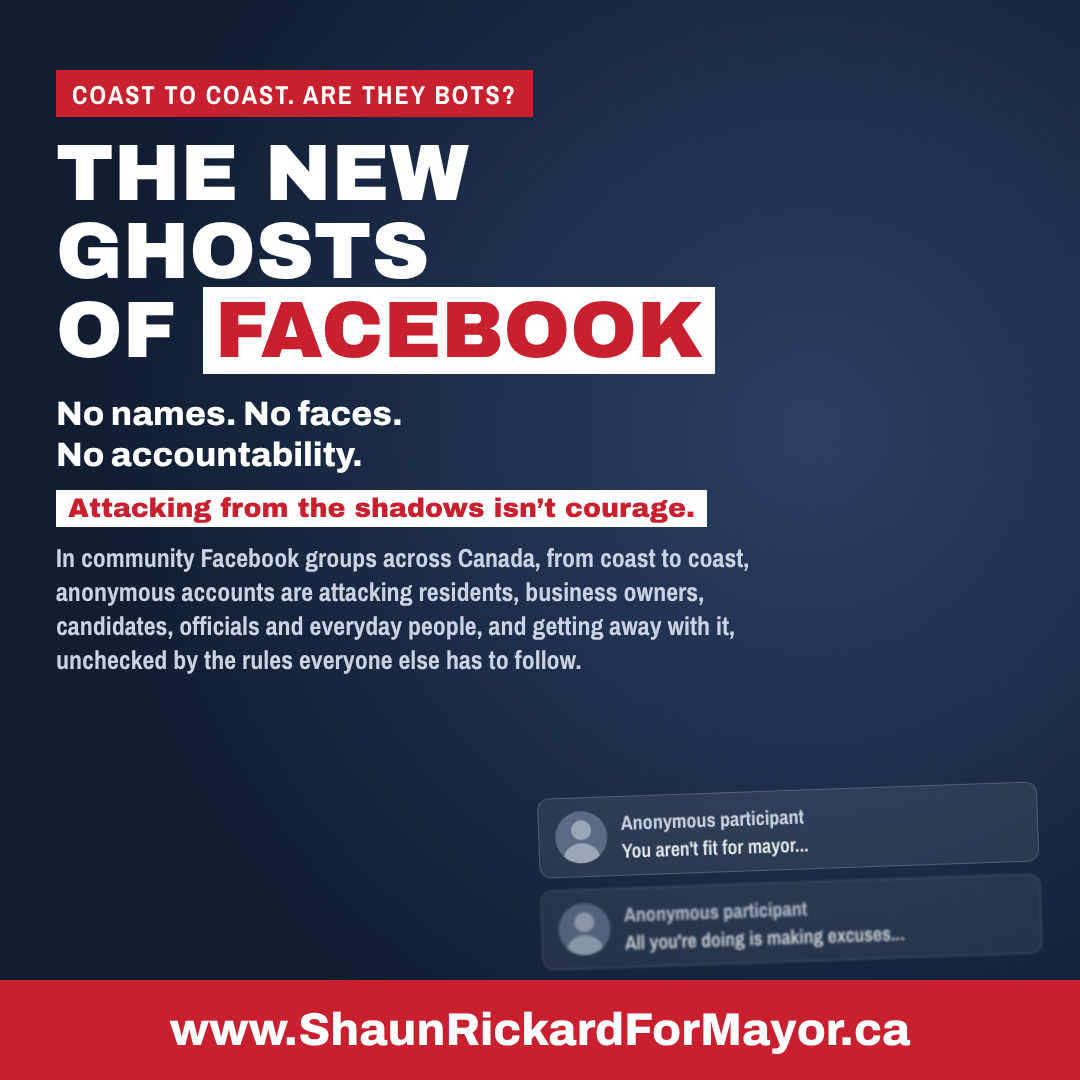
The New Ghosts of Facebook: Are They Bots? A Growing Problem in Communities Across Canada
They have no names, no faces and no accountability. In community Facebook groups across Canada, from coast to coast, "Anonymous participant" accounts are free to attack residents, business owners, candidates, officials and everyday people, unchecked by the rules everyone else has to follow.
Running for office means accepting criticism. I expected it, and I welcome it. Some of the criticism I've received during this campaign has been fair, and I've owned it publicly. Holding candidates to account is exactly what residents should do.
But something else has been happening in online community groups, here in Pickering and in communities right across Canada, and residents deserve to know about it.
Day after day, comments appear under a label that reads simply "Anonymous participant," followed by a number. No name. No photo. No way of knowing who they are, whether they live in Pickering or even in Canada, or whether they're even one person or several. In this campaign alone, I've received a steady stream of these comments, often several in a single day, across multiple groups, frequently repeating the same talking points in nearly identical words.
They call candidates names. They throw around accusations of corruption, racism and worse. They demand answers, and when they get them, they move on to the next attack. And the people they target can't see who is speaking, can't block them, and can't hold them to anything they've said.
In my opinion, this is bullying, plain and simple. Hiding your identity while you attack someone else's character doesn't make you brave. It takes no courage at all to throw insults from behind a blank profile. Courage is standing behind your words with your own name, the way every candidate on the ballot has to.
How "anonymous participant" works
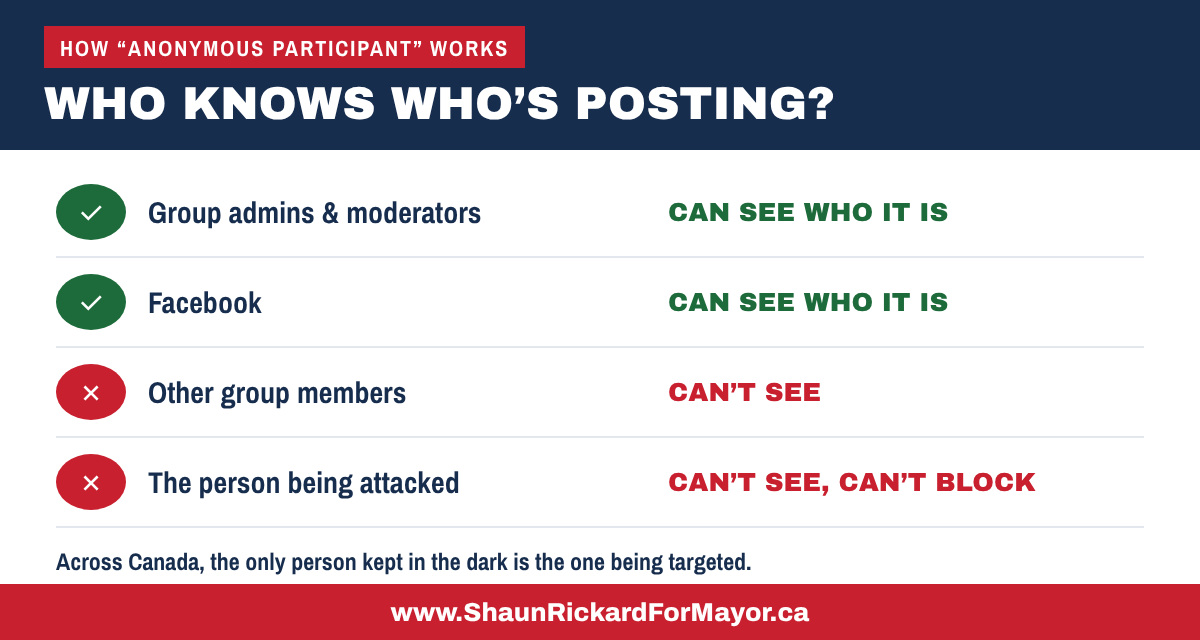
Facebook allows group administrators to switch on anonymous posting in their groups. When it's turned on, a member can post or comment without their name appearing. Other members see only a generic label, such as "Anonymous participant" in public groups. But the poster isn't truly anonymous to everyone. According to guides explaining the feature, their identity remains visible to the group's administrators, moderators and Facebook's own systems. Admins can also choose to require approval of anonymous posts before they're published.
In other words, the people being targeted are the only ones kept in the dark. The group's admins know who these accounts are. Facebook knows who they are. The candidate, or the resident, being attacked does not.
And because you can't see who is behind an anonymous comment, there's no profile to block. From what I've experienced, the only real options are to report a comment to Facebook or ask a group admin to remove it, and hope someone acts. Often, nothing happens. The next comment is already there.
Who are they?
I don't know, and that's the point. Some may be genuine residents who feel uncomfortable posting under their own name, and I understand that. But when the same accounts appear again and again, across different groups, using the same phrases and targeting the same people, residents are entitled to ask:
- Do these accounts belong to real Pickering residents, or to people living outside our city, or even outside Canada?
- Are they connected to other campaigns, or to people with an interest in the outcome?
- Is one person posting under several anonymous labels to make their views look more widespread than they are?
- Are some of them bots or fake accounts? Trolls looking for a reaction? Outsiders trying to influence local debates? Or people with a personal, political or even radical agenda?
- And above all, what is their purpose?
I'm not accusing anyone. I can't, because I can't see who they are. That's exactly the problem. The questions remain unanswered, and in the final days of an election, that matters.
Why do admins allow it?
Anonymous posting only exists in a group because its admins chose to turn it on. Admins can see exactly who is behind every anonymous comment. They can remove those comments, require them to be approved first, or switch the feature off entirely.
Yet in many groups, these accounts seem to have free rein. The same attacks keep appearing, day after day, with little or no moderation, while comments from people using their real names are sometimes held to a stricter standard. Residents are entitled to ask why.
- Why would a community group allow anonymous accounts to attack residents and candidates without consequence?
- Why are reports of harassment so often ignored?
- And, a question some residents have put to me: could some of these accounts belong to admins themselves, or people close to them? Only the admins know, because only the admins can see who they are.
I'm not accusing any particular group or admin. Many admins work hard, unpaid, to keep their groups civil, and I thank them for it. But when a group allows anonymous attacks to go unchecked, its admins should explain why.
Why can't you block or delete them?
When someone attacks you under their own name, you can block them, and you can see who they are. With an anonymous participant, there's no name and no profile, so there's nothing to block. In my experience, the person being attacked can't delete these comments either. Only the group's admins and moderators can remove them. That leaves the target with one option: report the comment and hope someone acts. Too often, nobody does.
Facebook built a tool that protects the attacker's identity, but gave the person being attacked no way to protect themselves. That has to change.
It isn't just me
This isn't just a Pickering problem, and it isn't a problem for one candidate. It's a nationwide problem. Across Canada, municipal candidates are reporting a rising tide of online abuse. In September, The Tyee reported on candidates targeted over their race, religion, gender and sexuality, much of it from anonymous accounts. Research cited in that report found that 40% of messages aimed at 2019 federal candidates were uncivil and 16% were abusive. In Kitchener, a council candidate became a lightning rod for online hate after posting a simple campaign video.
Candidates across the country say the same thing: this kind of abuse discourages good people from running at all, and it discourages residents from speaking up. I've seen that myself while knocking on doors, where many supporters have told me they're afraid to put up a lawn sign for fear of attacks from neighbours and online.
"Attacking from the shadows isn't courage. Anyone can say anything when no one knows who they are. Accountability starts with a name."
Why is this allowed?
Facebook created this feature to let people ask sensitive questions, about health, family or personal struggles, without embarrassment. That's a worthwhile purpose. But in local community groups during an election, it has become something else: a shield for attacks, with no consequences for the person behind them. And anonymity without accountability doesn't just protect the shy. It emboldens the most extreme and hostile voices, the people who would never say these things with their name attached, and gives them free rein to attack, smear and mudsling. That's not good for anyone, whichever candidate they support.
Defamation doesn't stop being defamation because it's posted anonymously. In Canada, people who are defamed online can go to court and ask a judge to order a platform to reveal who is behind an account. But that process is slow and expensive, and no candidate can do it in the middle of an election. In practice, for the length of a campaign, there is no recourse.
And it doesn't stop at elections. The same anonymous attacks hit local business owners, community volunteers, public officials and ordinary residents who simply share an opinion, in towns and cities from coast to coast in Canada. Every community in Canada that relies on online groups to talk about local issues is exposed to the same problem.
What needs to change
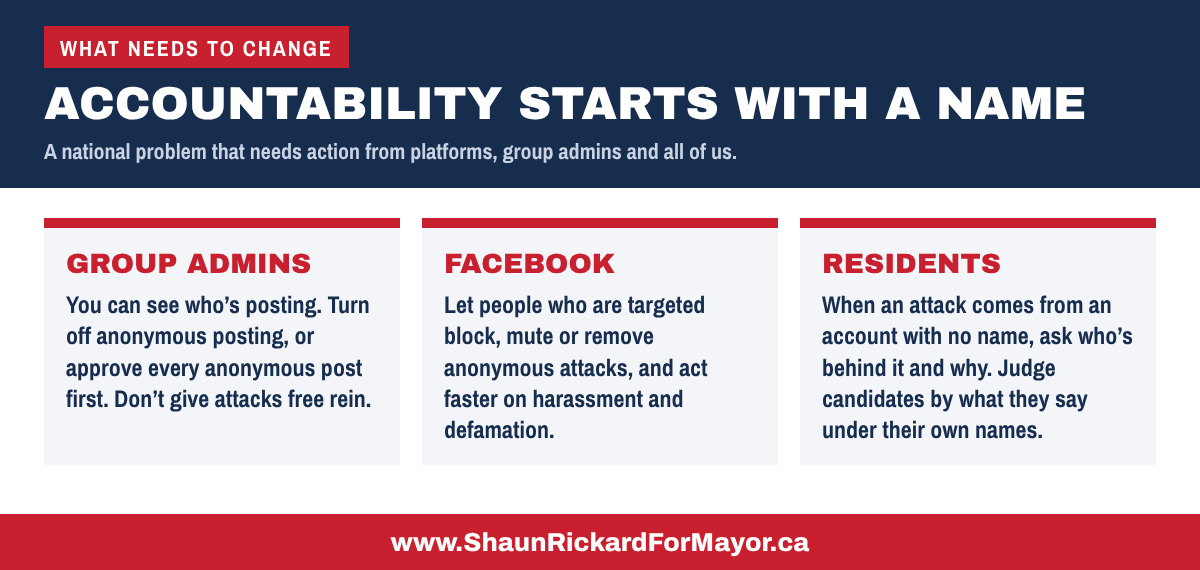
I'm asking for three simple things:
- Group admins: during election periods, please consider turning off anonymous posting, or at least require every anonymous post and comment to be approved before it appears. You can see who is posting. Please use that responsibility.
- Facebook: give people who are targeted a way to block or mute anonymous accounts, and act faster on reports of harassment and defamation, especially when elections are underway.
- Residents: when you read an attack from an account with no name, ask yourself who might be behind it, and why they won't put their name to it. Judge candidates by their records, their plans and what they say under their own names.
My commitment
I've answered every question put to me during this campaign under my own name, including the hard ones, and I'll keep doing that. If you have a concern, a criticism or a question, I want to hear it. Just tell me who you are. I'll answer you, person to person.
That's how a healthy community debate is supposed to work. And it's the kind of respect I want to bring back to Pickering, online and at City Hall.
Questions? Email me directly: Shaun@ShaunRickardForMayor.ca
My full platform: shaunrickardformayor.ca/platform
VOTE ONLINE NOW: intvoting.pickering.ca
Online voting runs until Monday, October 26 at 8 p.m. In-person voting on Election Day is Monday, October 26, from 10 a.m. to 8 p.m.
Sources
- The Tyee, "Harassment and Hate on the Municipal Campaign Trail," September 24, 2026
- CTV News Kitchener, "Municipal election candidates targeted by racist online comments," September 11, 2026
- Lilach Bullock, "How to Post Anonymously in a Facebook Group (2026)"
- Mark Kaley, "Anonymous on Facebook Groups? Not Really: How Anonymous Posts Can Still Be Traced"
- Facebook Help Centre, "Participate anonymously in a Facebook group"